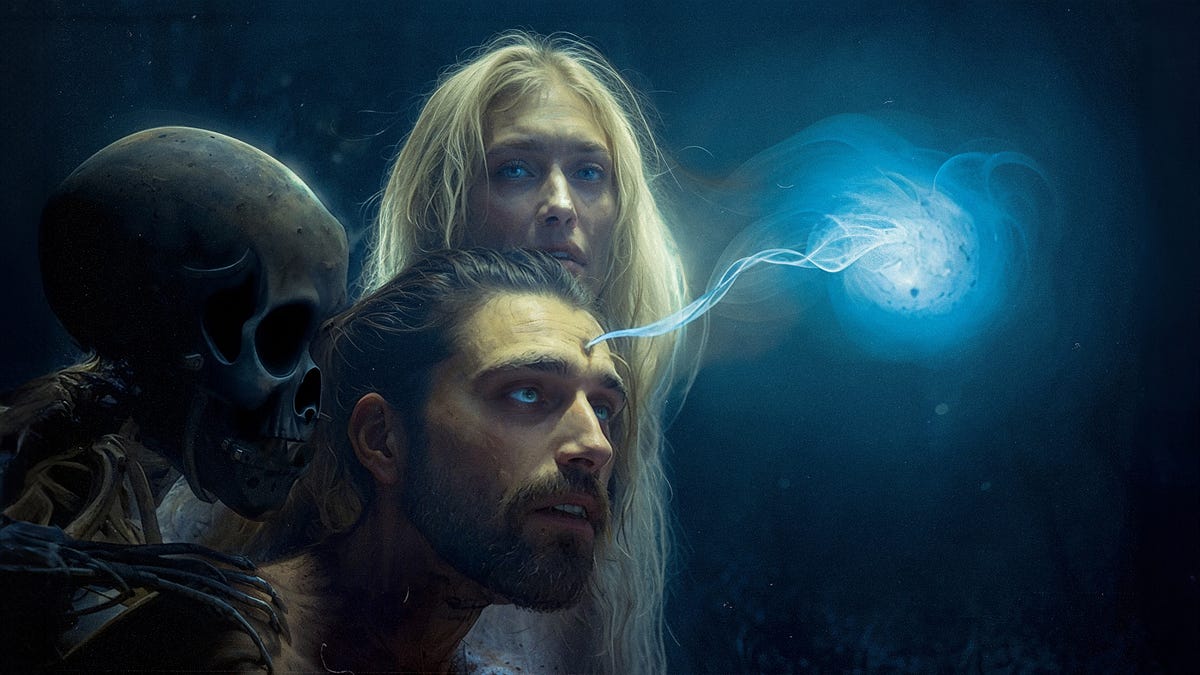
For much of human history, technique has been a way we've collectively identified talent, importance, and mastery. A painter who studies form, perception, and light for decades can put onto canvas what he sees in his own mind. This is where we first begin to conflate technique with meaning.
I have been a very lucky receiver of technique in my life. I've been able to use programs like Ableton and Cinema4D to bypass many years of discipline that were once necessary to create the same sonic and visual palettes — palettes that used to require multiple people, multiple studios, tens of thousands of dollars in hardware, and years of work.
This is a trend not just in music production, but in any form of creative human labor that results in progressive accumulation. We build from what our forefathers handed to us, crafting a generational ladder toward a purer creative playground. As this trend continues, we will soon lose the ability to use technique as a marker of meaning.
I have been producing for nearly twenty years, and yet there are undoubtedly fifteen-year-olds right now (on their fourth year of production btw) who have surpassed my technical abilities. Just as I surpassed many of my predecessors. With AI now in the picture, in ten years those same fifteen-year-olds will be directing entire immersive films from their iPhone 36.
But meaning… meaning is fickle.
It lives in the space between our breaths, between our waking mind and our unconscious. Meaning is a pattern — it can be thought of as a gravity well — attracting vectors between the internal self and the external world. Cultural meaning is where those gravity wells are shared across large groups of people.
Generative AI has quickly shown us that technique and aesthetics are not inherently tied to meaning. There is a vast amount of technically proficient slop out there. In EVERY medium. AI just reveals this at an unprecedented rate.
I see this as a good thing. The easier technique becomes to reproduce, the more humans will tune their internal compass toward felt meaning rather than novelty, technicality, or aesthetic proficiency.
Many digital artists find the same level of expression in a keyboard and mouse that painters find in a brush and oil. But for many years, digital art was largely non-monetizable outside of industry roles such as graphic design, branding, logo creation, concept art, and 3D assets for VFX or video games.
This has subconsciously trained the majority of digital artists to aim for photorealism, brand consistency, to execute what a director asks of them, and to solve pipeline problems like topology optimization. They are trained to optimize, not to express an inner world.
Identity forms around this. An identity built on solving problems, being helpful, reducing friction in a pipeline, an identity rewarded for consistently contorting artistic spirit into something useful and predictable. Cultural identity then forms on top of that. Hierarchies emerge, gatekeepers are anointed, and every new student learning digital art begins shaping their identity around technical proficiency rather than expression.
Then a tool arrives. A tool that optimizes better than any artist ever could. This tool doesn't merely threaten an artist's role in a pipeline but it threatens their identity. This is why so many creatives are not responding to AI as a technological threat, but as an existential and eventually ontological threat.
And so many artists are now asking: "How do we create value in a world where the very things we've historically been valued for are being automated?"
I have arrived at the conclusion that we've been valuing the wrong vectors all along. The cultural vectors I mentioned earlier are being moved, rearranged, and reconsidered at scale, in real time.
Where does meaning arise in a world where technique, optimization, and novelty are being solved? Creatives have relied on these three vectors for much of human history. They are clean, reproducible, and offer a form of "proof" that meaning must inherently exist. They also allow for comparison: technique can be evaluated objectively while meaning cannot.
A single artwork seen by one person could save a life. A piece of "slop" could be seen by millions and forgotten by the next doom scroll. How do you optimize that?
AI will attempt to mimic meaning. Meaning is messy, but it is still an observable pattern. Algorithms will try to optimize that pattern and they will fail, because meaning collapses when pursued directly.
The artist's future is a path of meaning, not technique, novelty, or efficiency. We must not optimize for meaning. We must stop optimizing for outcomes altogether. Friction is where meaning is born, and where algorithms die.